Announcements [Download PDF – German | English]
Software is getting more expensive every year, AI returns are still hard to prove, and Europe’s boards are rethinking who they depend on. Together, these trends point to a new deal between companies and their advisers: paying for results, not for time.
What are you actually paying for? A license that costs more at every renewal? Consulting days that end in a slide deck? An implementation project that takes a year before anything changes?
Now the harder question: what did it return?
Many executives struggle with the answer. In Gartner’s latest CEO survey, 44% of CEOs said they find it hard to demonstrate financial returns from AI to their stakeholders, yet 75% plan to increase technology investment (Gartner, October 2026). Spending more without proof is not a strategy that lasts.
Four market trends are converging on the same question: what are we paying for?
Each trend on its own is familiar. Taken together, they change what executives should expect from every supplier and every adviser.
Exhibit 1: Four trends, one direction
| Trend | What the data shows | What it means for executives |
|---|
| Software costs outpace value | SaaS inflation hit a record 16.4% in June 2026 and was 14.3% in early September data (Vertice). Companies leave 36% of SaaS licenses unused, and 61% of IT leaders had to cut projects because of unplanned SaaS cost increases (Zylo). | The license line grows faster than the value behind it |
| Sovereignty moves onto the board agenda | 61% of Western European CIOs expect geopolitics to increase their reliance on local or regional cloud providers (Gartner). In DACH, 83% of companies see a provider switching off critical services as realistic, but only 57% have an exit strategy (Lünendonk via E3). | Dependence on single suppliers is now a strategic risk |
| Pricing moves to outcomes | 18.7% of enterprises now use outcome-based pricing tied to agreed metrics, nearly level with per-user pricing at 17.1% for the first time (Futurum). Salesforce now charges some AI agents only per resolved case. | Buyers increasingly expect suppliers to own the result |
| Services become software | Investors describe a shift from software as a service to service as software, where the provider, not the customer, is responsible for the outcome (Foundation Capital). | Work that used to be bought as hours can be bought as a result |
The common thread is accountability. Whether the supplier sells software, services or both, the buyer increasingly asks for the result, not the means to reach it.
After software as a service comes results as a service
Software as a service freed companies from installing and running software. It did not free them from paying for it, year after year, whether the value arrived or not.
The next step is results as a service. The buyer no longer pays for access, hours or a project plan; the buyer pays for an outcome that has been delivered.
The C-suite is already moving in this direction. In the same Gartner survey, 63% of CEOs named a radical redesign of the operating model as a top move to accelerate financial returns from AI. Gartner’s advice to CIOs points the same way: reduce rigid dependencies so the company can switch providers, and measure outcomes rather than AI activity (Gartner, October 2026).
From consulting to results as a service: we want to be paid for results, not for time
Until now, clients have paid consultants primarily for time. From today, Rhino MC wants to be paid for results.
What changes for our clients:
- You pay for the result, not for consulting days
- You don’t wait months for an implementation. Results arrive in days and weeks
- You don’t need a separate system integration partner. Our products run next to your existing tools, and we handle the setup
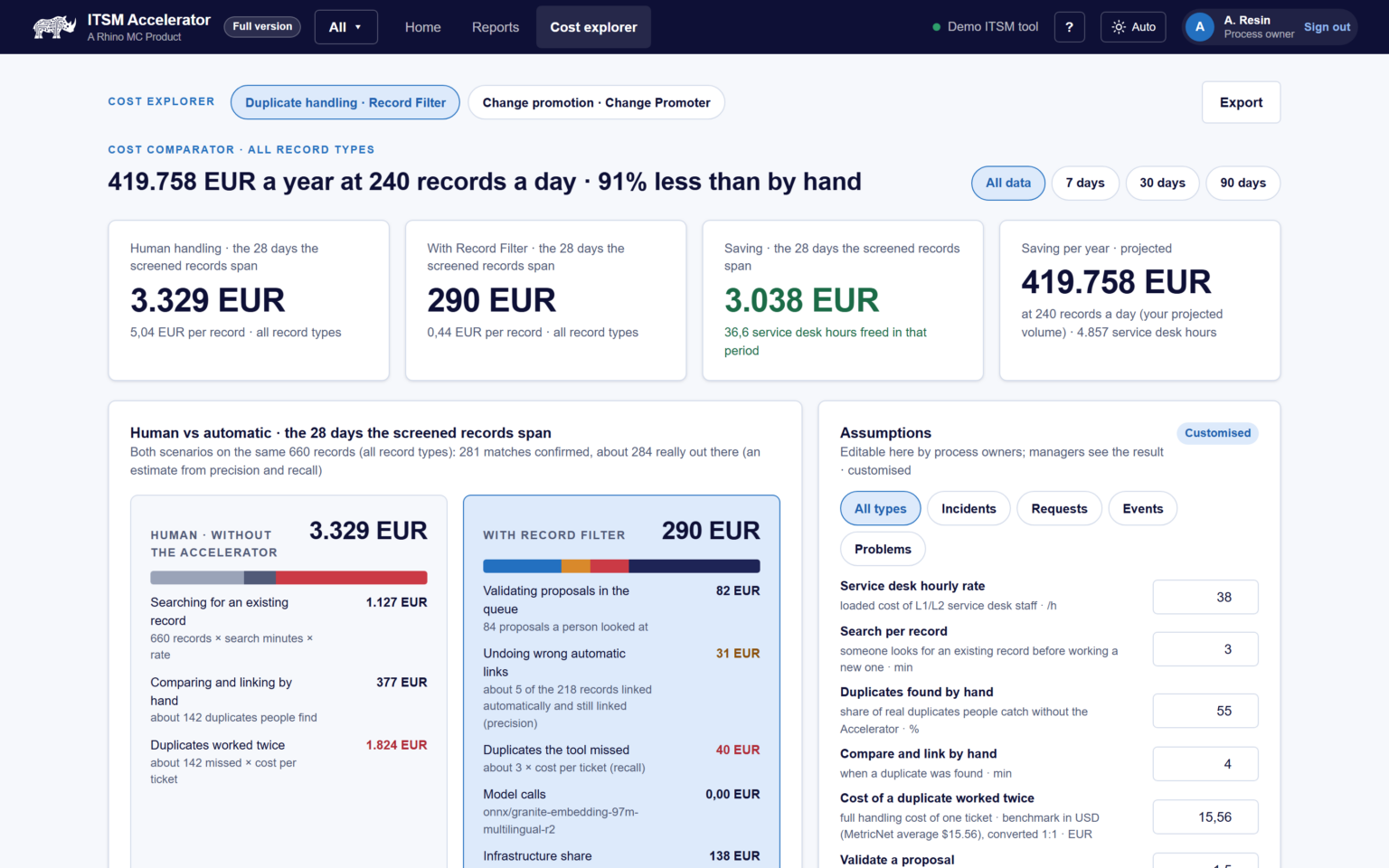
- You see the effect in the P&L. The result is designed to reduce running costs, starting with licenses
Human consultants and AI agents: one team, built for speed
To deliver results this fast, we have added AI agents to our team. One of them you can meet right away: Leni by Rhino MC. Leni explains our solutions in our videos and answers calls and chats about them. Others work behind the scenes alongside our consultants as well as in the backoffice.
Rhino MC is now a consultancy in which experienced people from the world’s leading consultancies work together with AI agents, on site, at the client.
The roles are clear (Exhibit 2).
Exhibit 2: Human consultants and AI agents, one team
| | AI agents | Human consultants |
|---|
| What they get | A clear goal | The client’s situation, people and priorities |
| What they do | Work through the task as an agentic system and reach a good first result very quickly | Bring judgment and experience to that result: what matters, what is missing, what to decide |
| What they are best at | Speed, scale and repeatable work | Context, trade-offs and change in the organization |
Neither replaces the other. The agents make the result fast; the people make it right.
What we learn once, we build into assets
AI agents open up something new for a strategy consultancy: we can build complete software products ourselves and make them available to our clients.
Every project teaches us something. Instead of carrying that experience from client to client in slides and heads, we turn it into assets: tools that automate parts of our own work and take the client to the result much faster. What took a team weeks in the last project becomes a starting point in the next one.
The Rhino Technology Marketplace is where these assets live.
Corporate-grade transformation at boutique economics
Until now, complex individual transformation programs were something mainly large corporations chose to invest in. Many of Rhino MC strategy consultants gained their experience there. For most Mittelstand companies, they would have been too big, too inflexible, and too expensive.
People and AI agents together change that equation. The same experience, combined with assets that do much of the routine work, makes this kind of advice affordable for mid-sized and larger Mittelstand companies, in a very short time: boutique economics instead of corporate budgets.
We do this for a reason. We want to accelerate transformation in Germany and take it to the next level, by bringing premium results to the companies that carry much of the German economy.
The value comes from two levers: the P&L and sovereignty
Lever 1: direct P&L impact. With SaaS prices rising at double-digit rates, every license that is no longer needed is a saving the CFO sees immediately. This is value that does not need a business case to prove it; it shows up in the next renewal.
Lever 2: sovereignty. Sovereignty does not mean building everything yourself. It means depending less on any single supplier, so that their pricing or roadmap no longer decides yours, and having real choices in the market.
The two levers reinforce each other. A company that controls more of its own landscape pays less for it, and negotiates from a stronger position when it does buy.
We are just getting started: the Rhino Technology Marketplace
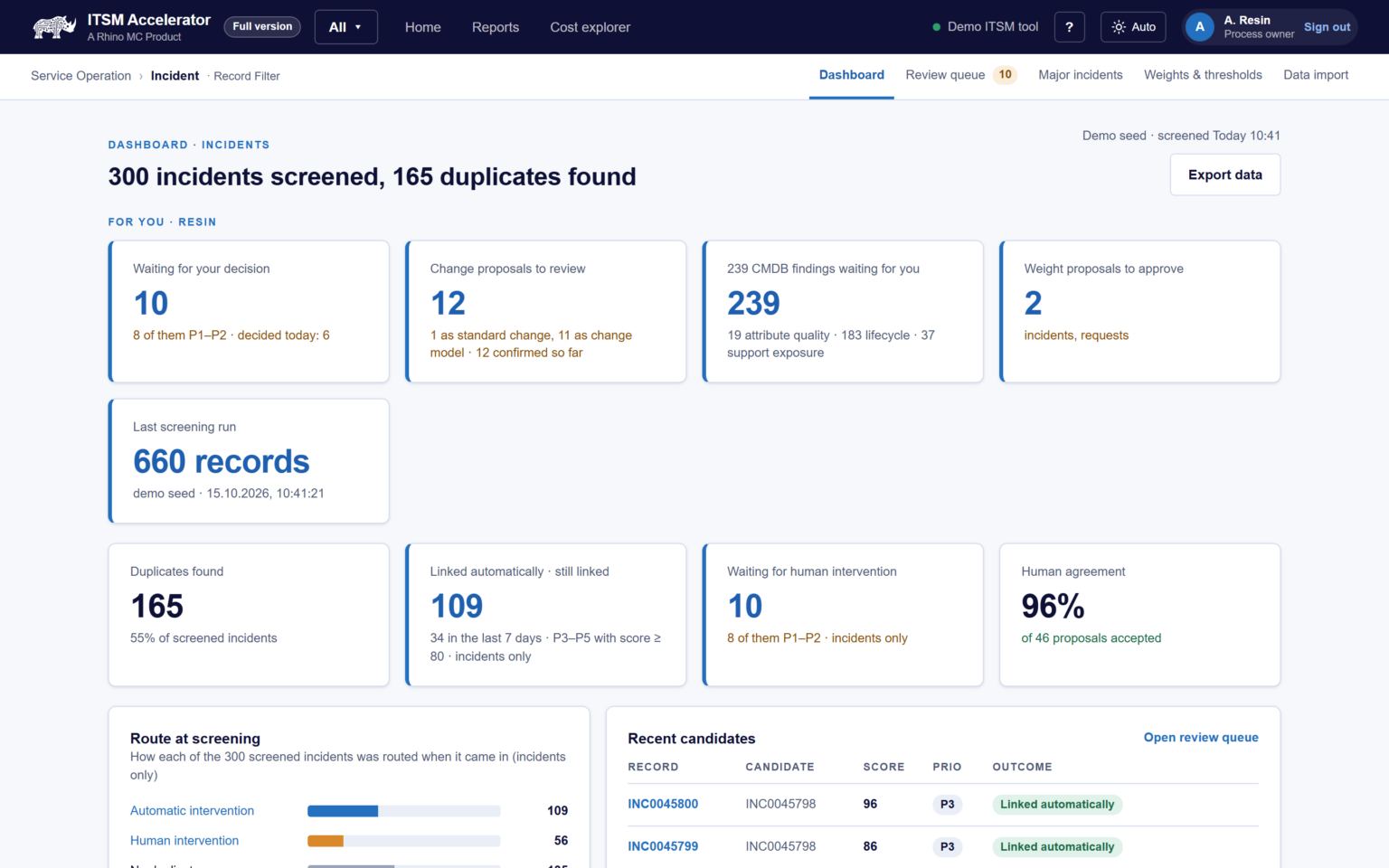
Rhino MC Service Management Accelerator for IT is one of the first products in the Rhino Technology Marketplace, next to the IT Org Fitness Check, the “Triple A” AI Readiness Check and the Sovereign AI & App Builder. More will follow.
IT service management (ITSM) shows the shift particularly clearly. A substantial share of the work is recurring, it runs on expensive SaaS platforms, and it is where license costs and supplier dependence show up.
The result, agreed up front. Before any work starts, we agree with you what Rhino MC ITSM Accelerator will deliver:
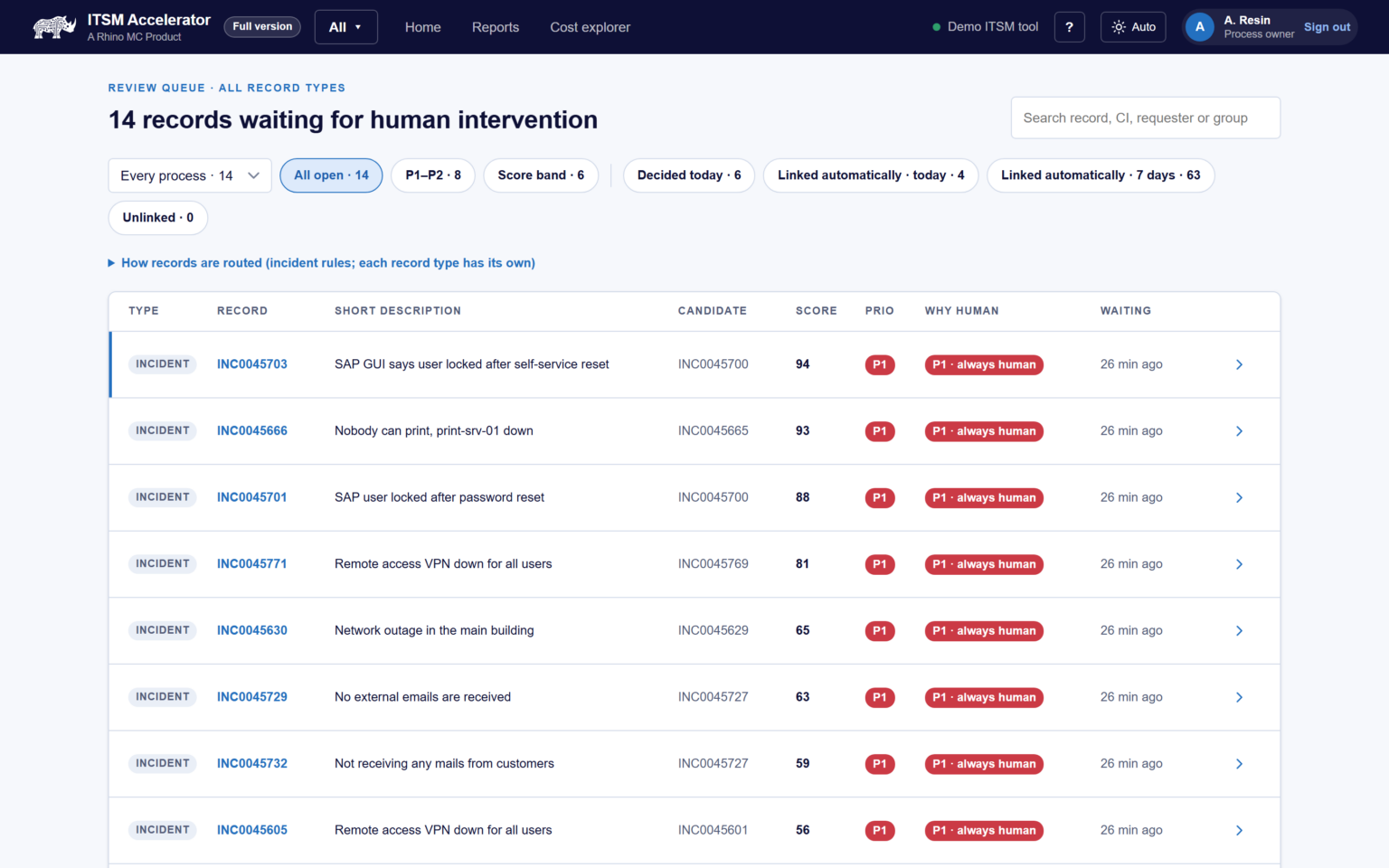
- duplicate tickets found before a service desk agent opens them
- the changes that keep repeating, ready to become standard changes
- Configuration Management Database (CMDB) data quality made measurable, with empty, implausible or end-of-life record named
Accepted by your people. The AI agents propose; owners accept or reject each finding with one click. Nothing goes live automatically, every decision has a named owner and is recorded in an exportable audit log. Rhino MC ITSM Accelerator runs alongside all major ITSM tools such as ServiceNow, Jira and Freshservice.
In this 60-second video, Leni, our AI agent, shows Rhino MC ITSM Accelerator at work.