From the outside, our offices are hard to miss.
A historic villa in Bad Homburg. A prime location in Düsseldorf, surrounded by Tier-1 strategy firms. Architecturally, both locations make a statement.
Yet the appearance is secondary.
What matters is what happens inside.
At Rhino Management Consulting, offices are not treated as infrastructure, but as environments designed around a specific way of working: intense collaboration, rapid iteration, and outcome-driven discussion. The setup follows a clear logic—different spaces for different types of work.
Bad Homburg – Where Strategy Gets Built
The headquarters on Louisenstraße 120 forms the center of this setup. The ensemble is less a traditional office than a deliberately structured working environment.
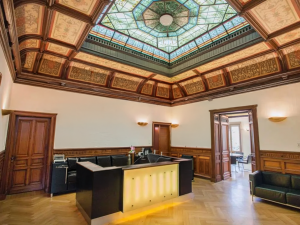
Villa Hammelmann, a former heritage museum, now serves as the firm’s client conference center. The atmosphere is quiet, focused, and removed from the standardized setting of typical corporate meeting rooms. It is here that executive discussions take place—on operating models, leadership alignment, and strategic direction. The environment is designed to support clarity and concentration.
A few steps away, the Coach House presents a different picture. More functional, more direct. This is where the actual work unfolds: models are developed, assumptions challenged, and concepts iterated. What appears as a structured framework in a presentation typically originates here, through multiple cycles of refinement.
The surrounding park and pavilion extend this setup. They are not decorative elements, but part of the working model. Walking discussions and outdoor sessions are used deliberately, particularly when topics stall in conventional settings. The effect is pragmatic rather than symbolic: discussions tend to move forward more quickly.
Düsseldorf – Where the Team Comes Together
The Düsseldorf location serves a complementary role. Situated in the former WestLB headquarters, in close proximity to leading consulting firms, it reflects the firm’s presence in one of Germany’s most relevant economic regions.
Internally, however, its primary function is different. Düsseldorf acts as a team hub. It is where project teams come together after extended remote phases, where alignment is re-established, and where collaboration is intensified.
The space is used for concentrated working sessions, joint problem-solving, and client workshops. In this context, proximity is less about representation and more about execution: reducing friction, increasing speed, and maintaining cohesion across distributed teams.
What Makes the Difference
The external appearance of an office is relatively easy to shape. The more difficult task lies in creating an environment that measurably improves how people work.
Three factors stand out.
First, focus: spaces that allow for sustained, undisturbed thinking.
Second, interaction: setups that encourage direct exchange rather than passive participation.
Third, energy: environments that people actively choose over remote alternatives.
Together, these elements determine whether an office contributes to output—or remains symbolic.
What’s Next
The model is being expanded. Additional locations are under consideration, with Lisbon among the most prominent.
The underlying idea remains consistent: to establish environments that enable collaboration by design, rather than by policy.
Our Take
Offices alone do not create impact.
But well-designed environments, used with intent, can make a measurable difference—both in the quality of decisions and in the speed of execution.
At Rhino MC, this principle is applied internally with the same rigor that defines its client work.
Data-Driven, Expert-Enhanced, & Industry-Specific
AI Check for Germany
Discover where your company stands in AI adoption with our AI-Readiness Check—get a tailored assessment, benchmark against competitors in Germany, and receive clear next steps for your AI journey

Share this article on social media: